My Son Bought His First Beer at Seven Years Old
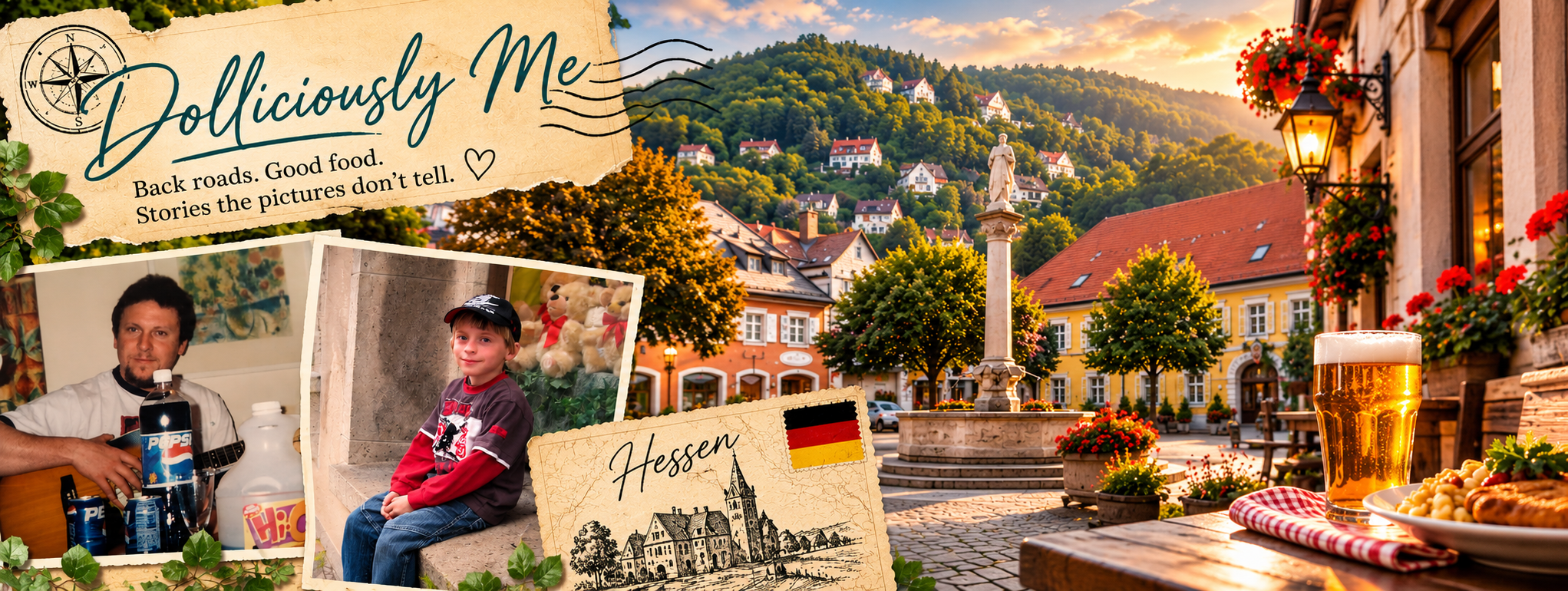
Yes, you read that correctly. My son bought his first beer when he was seven years old.
Not in some back-alley transaction. Not because he'd figured out how to fool the local bartender. He rode his little bicycle down the street to a family-owned restaurant in our village in Germany, ordered dinner and a beer for his daddy, paid for both, and rode home.
And nobody thought a thing about it.
David and I had a running list during our years overseas. We never actually wrote it down, but we added to it often enough. It was our unofficial collection of Things That Would Never Happen in the States.
Randy buying a beer at seven years old certainly made the list, right up there with portable kitchens. But it wasn't the first entry.
That honor belongs to a guitar and a series of events that happened within the first week.
When Dave first arrived in Germany, he discovered pretty quickly that despite their ad boasts, Visa wasn't every where you needed it to be.
We were accustomed to pulling out a card and going about our business. Germany, or at least the little village where we first landed, had other ideas.
The only place in the entire village that accepted our cards was the hotel. Restaurants, shops, pretty much everywhere else operated on cash.
We were living in a German economy, and had no practical way to get our hands on the local currency.
So for the first couple of weeks, Dave's world was considerably smaller than he'd anticipated.
He could walk around the village, explore the streets, look in shop windows, and get acquainted with his surroundings. But when he got hungry, he had to return to the hotel. It was the only restaurant where he could actually pay for a meal.
Imagine traveling all the way to Germany, surrounded by new foods and places to explore, and being financially tethered to a hotel dining room. (In all fairness it was a phenomenal dining room and we very much enjoyed our time at the Lindner.)
Now, Dave is a musician. He studied music in college, and an unfamiliar town with a music store is pretty much an invitation he isn't going to ignore.
One day, while exploring, he wandered into a little music shop. He looked around, picked up a guitar, played for a few minutes, and put it back.
The shop owner approached him.
"No, no, no, no. You keep."
David tried explaining that he couldn't. He didn't have any cash, his cards weren't working, and he wasn't in a position to buy a guitar. He also didn't speak German yet, which made the whole conversation a little more interesting.
Fortunately, the shop owner spoke a little English.
"No, no. You bring back when you have money."
And just like that, David walked out of a music store carrying a guitar he hadn't paid for.
No deposit. No paperwork. No credit card on file. The man didn't even ask for his name.
He simply trusted a complete stranger to bring it back and pay him later.
Now, tell me how often that happens in your town!
David took the guitar down to the village courtyard and found himself a spot near the fountain. He sat down and started playing, just enjoying having an instrument in his hands again.
Before long, people began tossing coins into his guitar case.
He hadn't set out to perform. He certainly hadn't planned to earn money. But there he was, unintentionally busking in a German village.
And for the first time in a couple of weeks, he had enough cash in his pocket to eat somewhere other than the hotel.
All because a German shopkeep had handed an American stranger a guitar and trusted him to do the right thing.
David kept that guitar for several weeks. Once we finally got a German bank account established and had access to our money, the first thing he did was return to the shop, pay the owner, and thank him for what amounted to a rather extraordinary rental arrangement.
We loved that story then, and I still love it now.
It wasn't just the guitar. It was the assumption behind it. The shop owner had no reason to believe David would come back, other than the simple expectation that he would.
That kind of trust was something we encountered more than once during our time in Germany.
Which brings me back to my seven-year-old beer buyer.
By then, we were living in a small village in Hessen, in the same four-level townhouse I've written about before. The one that came without a kitchen. (If you haven't read "Where the Heck is the Kitchen" yet, you may want to check it out.)
Our little village had a family-owned restaurant about a block from our house. Randy was seven, spoke fluent German, and was comfortable navigating his little corner of the world on his bicycle.
David was home sick one day, and I had gone out to run errands.
Randy decided his daddy needed something to eat. And apparently, something to drink.
So he got on his bicycle, rode down to the restaurant, and ordered a meal and a beer for his father.
In German.
He explained to the people at the restaurant that his daddy was sick and he was bringing him something to eat.
They sold him the food.
And the beer.
When I arrived home, Randy was just getting back. He was so proud of himself, and the first thing he handed over was the beer. Then came the food.
Now, I can only imagine how that little transaction would have gone over at a restaurant in the States.
A seven-year-old walking in, announcing that his daddy was sick, and asking to buy him a beer?
I suspect there would have been a few questions.
But in our little German village, it wasn't treated as some great scandal. Randy wasn't trying to buy alcohol for himself. He was a child running an errand for his father, and the people at the restaurant understood exactly what he was doing.
They may well have recognized him. There weren't many expats living in our village, and Randy spoke German fairly well. But whether they knew him or not, nobody seemed particularly concerned.
And Randy? He was delighted that he'd taken care of his daddy.
We praised him for being thoughtful and helping out. Later, David and I had ourselves a good laugh over the whole thing.
And onto the list it went.
Things That Would Never Happen in the United States.
Looking back, what strikes me about those two stories isn't really the beer or the guitar. It's how differently people can approach the same ordinary situations.
An American man walks into a music shop without enough money to buy a guitar, and the owner sends him home with one anyway.
A seven-year-old boy walks into a restaurant to buy his sick father dinner and a beer, and the people behind the counter help him do exactly that.
Both stories involve a kind of everyday trust that Dave and I found remarkable. Neither was a grand gesture. Nobody was trying to teach us a lesson about life or culture. People were simply going about their business, doing what made sense to them.
And there we were, two Americans quietly adding another entry to our list.
That, to me, is the good stuff.
There's a term floating around the travel world these days called Lore-Tripping. Depending on who's using it, the definition seems to wander a little.
From what I gather, the idea is to skip the overcrowded tourist traps and go looking for smaller, quieter places with history, character, and stories worth discovering.
Naturally, I was tickled pink. These are my kind of people! I've been wandering off the beaten path for years, and now somebody's gone and made it a trend. I dove into the articles, curious to see what wonderful little places these young folks had discovered that I might have missed.
And then I saw the recommendations.
Myrtle Beach. Branson. Pigeon Forge.
Y'all, I nearly fell out of my chair.
Now, don't get me wrong. I enjoy a good funnel cake, a little live entertainment, and a roadside attraction as much as the next person. But whoever decided Myrtle Beach was an undiscovered destination apparently hasn't tried finding a parking space there in July. And Pigeon Forge? Good Lord, that place has enough pancake houses, dinner shows, and miniature golf courses to keep a family of twelve occupied until the Second Coming. And I've been stuck in a traffic jam in Branson at midnight in the off season!
I like all three places just fine, but calling them quiet, hidden gems is stretching the truth so far it might need a chiropractor.
Still, the idea behind lore-tripping got me thinking. I've apparently been doing some version of it most of my life. I just didn't know there was a name for it. And while I love a magnificent castle, a beautiful cathedral, or a famous landmark as much as anybody, those aren't necessarily the things I remember most.
I remember wrong turns that became wonderful afternoons, little restaurants where nobody spoke English and the food was worth every bit of confusion, and towns where we stopped to stretch our legs and somehow stayed for hours. I've wandered through farmers markets, poked around old buildings, found swimming holes, and followed roads simply because they looked interesting. Sometimes we found something wonderful. Sometimes absolutely nothing. And occasionally, we found ourselves wondering how in the heck we were going to get back to civilization. (This is exactly how I became a stowaway once, but that's a story for another day.)
That's the beauty of lore-tripping, at least the way I see it. You don't have to travel halfway around the world or follow an itinerary published en masse. Sometimes the best stories are waiting in a little town you've driven past a hundred times, or in an ordinary afternoon that turns out to be anything but ordinary.
Randy is grown now, with a family of his own. But somewhere in our collection of family stories, he'll always be that proud little boy riding his bicycle home through a German village, carrying a beer for his daddy. And David will always be the American who went to Germany with two perfectly good credit cards and wound up playing guitar for his supper.
I've been collecting stories like these for years, from faraway places to the back roads closer to home. Some are funny, some are a little ridiculous, and a few still leave me shaking my head. I've got plenty more to share.
Welcome to lore-tripping, Dolliciously Me style.
Back roads. Good food. Stories the pictures don't tell.
You didn't think that was my only story, did you?
Oh, honey. I've got stories. Some involve travel. Some involve food. Some involve things that seemed like perfectly good ideas at the time.
Sign up and I'll send the next one your way. No telling what kind of trouble we'll get into.
Well, look at you! You're officially along for the ride!
Thanks for joining me! I'm tickled to have you here. There are plenty more back roads to wander, good meals to find, and stories that probably shouldn't be nearly as funny as they are.
Keep an eye on your inbox. You never know where we're headed next!
— Dollie Jean